
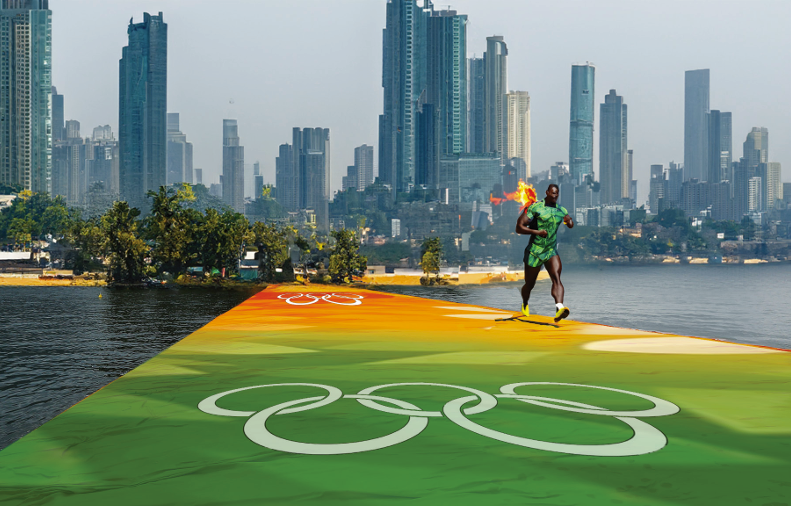
In response to the escalating challenges of climate change and urban resilience, BACA has proposed a paradigm shift in how major global events like the Olympics and the Football World Cup are hosted: moving them onto water-based platforms. Exploring the benefits and implications of relocating mega events onto water, the study sits at the intersection of architecture, urban planning and environmental sustainability.
Traditional land-based mega events often place significant strain on infrastructure, transport networks and local environments. Floating platforms can adapt to rising sea levels and extreme weather, reducing the risks associated with climate change. Water surfaces offer vast expanses of adaptable space for creative event layouts and spectator experiences, and floating structures can integrate solar panels, wave energy converters and advanced water management systems to cut carbon footprints and resource use. Repurposing existing maritime infrastructure can also catalyse investment in waterfront regeneration and public amenities.
The cost of hosting mega events on land has risen sharply, with little economic return to justify the traditional model. The 2016 Rio Olympics cost Brazil over $13 billion and left underused venues behind, from the Olympic pool that turned green to a deserted Maracanã stadium. Research by Müller, Gogishvili and Wolfe (2022) into major sporting events from 1964 to 2018 found them economically unsustainable in nearly every case, with the 2000 Sydney Olympics the exception. Beijing 2008 had a total budget of $43.13 billion, and Tokyo 2020 cost between $15.4 and $35 billion, with the Olympic Stadium alone costing $2 billion. Land-based events can also bring resident displacement, neighbourhood disruption, carbon emissions and habitat loss.
London 2012 successfully reused venues such as Wembley Stadium and the O2 Arena, yet its Athletes' Village cost $1.36 billion, more than 10% of the total budget, and was later sold at a substantial loss. Paris 2024 favoured existing venues to limit new construction, but its Athletes' Village still took 21% of the total budget and half of the construction budget.

Key facilities such as the Olympic Stadium, Aquatic Centre, Gymnastics Arena, Cycling Velodrome and Athletes' Village could be designed as modular, transportable floating venues. A stadium built in sections could be shipped by sea, assembled offshore for the athletics and opening ceremonies, then dismantled and moved to another coastal city for reuse or lease. A floating Aquatic Centre could be towed between cities to host international swimming championships, and the Athletes' Village could become a relocatable complex of prefabricated units, leased or repurposed for housing after the Games. Venues better suited to land, such as the equestrian field, could use existing facilities in the host city.
From the Mongolian steppes to the Arctic tundra, nomadic cultures have long lived in portable dwellings that can be put up and taken down as they move, following the seasons and the resources around them. Applying this thinking to mega events creates an opportunity to build large-scale floating buildings and infrastructure, and to lease them to host cities. Through floating assets, major events could become sustainable both economically and environmentally.
View the full PDF here:
Download