Contemporary artist Ai Weiwei documents ‘memory’ by preserving cultural history, human struggles and social injustices through powerful installations, films and photography. Pablo Picasso’s black-and-white Guernica (1937), which I have visited many times, is a powerful anti-war painting depicting the bombing of Guernica during the Spanish Civil War. Hokusai’s The Great Wave off Kanagawa (1831), a famous woodblock print showing a massive wave threatening boats, inspired the cover of BACA’s first book, Aquatecture: Buildings and Cities Designed to Live and Work with Water.
August 2025 marks 20 years since Hurricane Katrina. As I promote flood mitigation and preparedness to politicians, municipalities, homeowners and students, significant floods continue to occur around the world each year. This year, we have witnessed flooding in Texas, Spain and Manila.
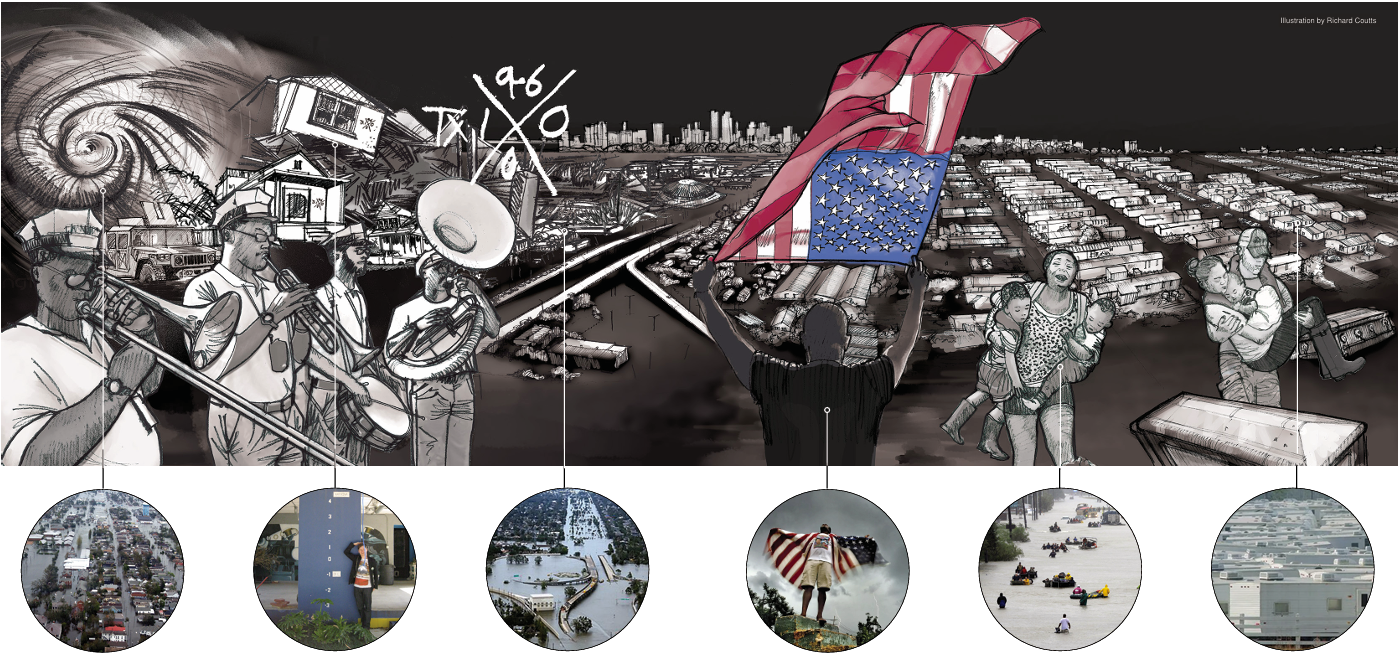
My contribution, for what it is worth, is simply titled KATRINA (2005–2025). The drawing begins with New Orleans’ brass and jazz bands, vibrant symbols of the city’s musical heritage. Blending jazz, funk and R&B, they perform at parades, second lines and celebrations. Musicians captivate audiences at Preservation Hall, in Frenchmen Street clubs and on the streets of the French Quarter. But behind the musicians, a storm is looming in the Gulf of Mexico.
Hurricane Katrina struck the Gulf Coast on 29 August 2005, devastating New Orleans and surrounding areas. Levee failures caused catastrophic flooding, displacing thousands. Over 1,800 lives were lost, and rescue efforts were delayed, exposing systemic failures. The storm had lasting effects on infrastructure, communities and US disaster management policies. Katrina disproportionately affected low-income and elderly populations.
Hurricane Katrina’s devastation was exacerbated by major levee breaches at the 17th Street Canal, the London Avenue Canal and the Industrial Canal, flooding around 80% of New Orleans. The city’s infrastructure, including key roads, was severely damaged, hindering evacuation efforts. Toll road barriers were designed to allow traffic in one direction, restricting the flow of evacuating vehicles. Additionally, many elderly residents refused to board evacuation buses, unwilling to leave their pets behind.
Timber-framed houses were uprooted. Many were smashed apart, while others were deposited intact but out of context, in a field or on a highway. For many homeowners, all that remained were concrete steps leading to the memory of where their home once stood.
My friend and colleague Professor Elizabeth English has made significant contributions to preserving New Orleans’ architectural heritage, particularly through her work on shotgun-style and camelback houses. These historic homes, including those with distinctive ‘camelback’ rooflines, are iconic features of the city’s residential architecture. Her endeavours helped preserve several examples. One is shown in the drawing behind the musicians.
The ‘man with the American flag’ from Hurricane Katrina is Robert Green Sr. In Ted Jackson’s photograph, Robert is draped in his mother’s casket flag as he stands on the steps that once led into her Lower Ninth Ward home in New Orleans on 31 August 2007. Green’s mother died while clinging to the roof, and his granddaughter perished in the floodwaters. Long-standing residents of New Orleans were accustomed to battling the forces of nature, but human failures proved far more brutal. Thousands endured days of hardship inside the Superdome, waiting for assistance. Much of the destruction that followed the storm was human-induced: a mix of systemic racism, exploitation, corruption and neglect that has continued to affect the city’s quality of life in the years since.
Robert kindly shared a cup of tea with me two years later in his new home as he recounted his family’s story. The image at the centre of my drawing is not a reproduction of Ted’s photograph, but seeks to convey a similar sense of loss and helplessness while under the protection of the Federal Emergency Management Agency (FEMA). Rendered in red and blue, it is the only block of colour in the drawing and highlights the importance of foresight and governance.
FEMA’s response to Hurricane Katrina in 2005 was widely criticised for delays and mismanagement, but the agency also provided significant assistance. It supplied trailers and mobile homes arranged in regimented grids. Against a backdrop of devastated townscapes, these formations evoked, for me, chilling memories of Second World War concentration camps. Street lighting was scarce.
Military vehicles were brought in to help, many still fitted with armaments. We advised that these be removed and that temporary street lighting be prioritised to provide a sense of normality in very trying conditions.
Many buildings had brown roofs covered with stones and shingles. Intense winds whipped up this material, shattering windows. These roof types are no longer specified, with softer green roofs taking their place.
FEMA’s markings, known as ‘X-codes’, were spray-painted on buildings during search-and-rescue operations. Each ‘X’ had four quadrants: top, the inspection date; left, the rescue team’s code or identifier; right, hazards such as gas leaks or structural risks; and bottom, the number of bodies or people found. These ‘tags’ marked every building, leaving a lasting scar on its fabric. They appear throughout the drawing.
Intense flooding also caused widespread damage to New Orleans’ cemeteries, many of which traditionally use above-ground tombs and caskets because of the city’s high water table. Floodwaters dislodged caskets and vaults, carrying them away from their resting places. The foreground of the drawing shows these floating caskets. Some drifted into streets, neighbourhoods and distant areas, causing emotional distress for families and logistical challenges for recovery teams. Like the mobile homes, the caskets form a geometric pattern, but have broken free of their grid; their tragedies are intertwined.
Have lessons been learned since Katrina?
There has been clear progress in some areas, but not everywhere. By contributing to the memory of Hurricane Katrina, I hope to offer a timely reminder that such disasters are likely to recur in our lifetime. Constant vigilance and preparedness can stand communities in good stead.
UK summers grow drier year by year; Yorkshire and Cumbria flood repeatedly, while Somerset, the Thames Valley and East Anglia contend with ageing defences.
One lesson is clear: we need to shift from reliance on man-made flood defences towards nature-based solutions, supported by binding legislation that outlasts a four-year political cycle.
Without this memory, history can often repeat itself.