
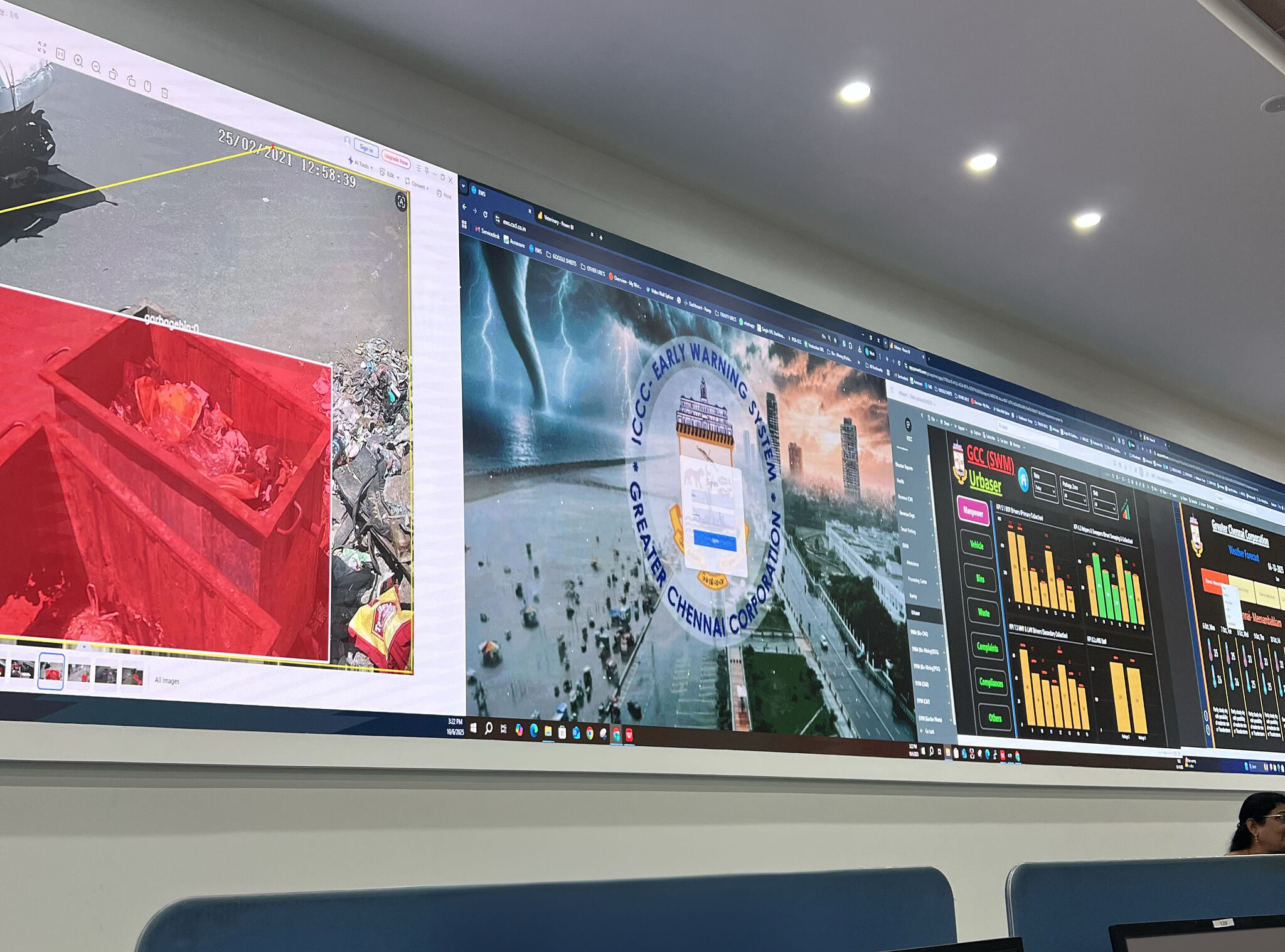
Foresight and memory are two of the core components of flood resilience. If we do not learn from the mistakes and errors of past disasters, we will repeat them.

Following another spate of heavy rainfall across the United Kingdom, the issue of flooding once again found itself high on the national agenda.
BACA’s Robert Barker was invited by the BBC News to appear as expert commentator on their item regarding further devastating flooding, of real concern to millions of homeowners and businesses.
Robert discussed both current and proposed flood-risk management techniques that BACA are employing to help clients and planners protect homes and businesses from the expense and distress of flood damage. Larger-scale proposals were also introduced, that would make whole areas resilient to flood-risk, rather than just individual buildings. Innovative uses of parkland areas and car parks for water storage during flood events, alongside cutting-edge underground water storage systems, are just some of the measures that BACA is utilising effectively to reduce flood damage.
Robert also explored BACA’s radical proposal for government to create specific areas that would lie outside of traditional planning regulations by granting an Innovation Licence. These areas would be breeding grounds for innovation, where companies and individuals could explore revolutionary new ideas and build and develop them.
New methods that proved effective could then be permanently licenced and employed in the development of technology to reduce the increasing threat from flooding.
Following another spate of heavy rainfall across the United Kingdom, the issue of flooding once again found itself high on the national agenda.
Read More
After almost 10 years the practice still has 100% planning success.
This year, amongst others, BACA architects helped to achieve planning consent for 670 new homes as mixed-use redevelopment of a major brownfield regeneration site in Norwich; and secured planning consent for one of the most ambitious houses of the 21st century – and it is designed to passivhaus.
After almost 10 years the practice still has 100% planning success.
Read More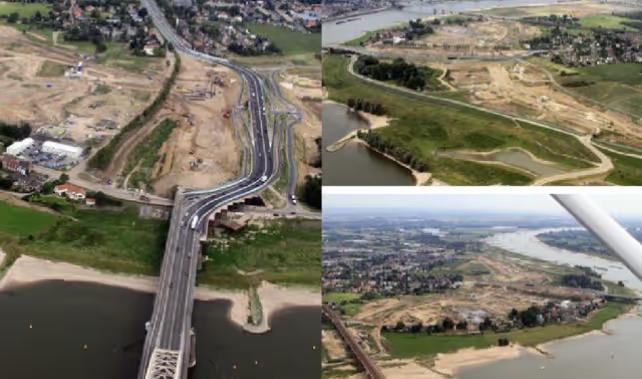
In Nijmegen, Netherlands construction work has started on the new flood relief channel and associated works, including the new road bridge.
The project is one of the largest ‘Room for the River’ projects in Europe, creating a 1km flood relief channel, super dyke, 3 new bridges and a new marina.
In Nijmegen, Netherlands construction work has started on the new flood relief channel and associated works, including the new road bridge.
Read More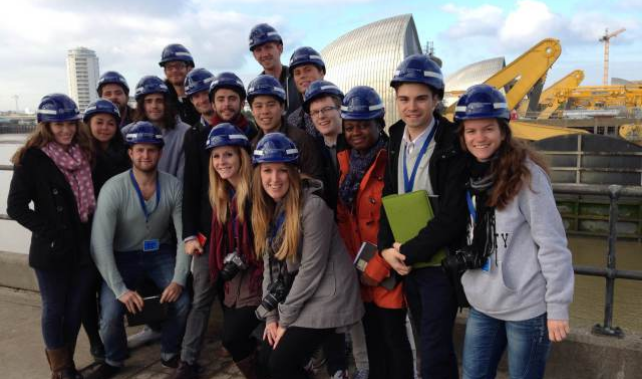
Masters in Architecture students at Oxford Brooks university enjoyed a visit from BACA director Robert Barker to help with their projects on Flood Resilient Baroque.
Robert said ‘it was a thoroughly enjoyable day, helping the students with all sorts of issues from floating construction, osmotic power stations through clockwork design and hydroponic plants’.
Masters in Architecture students at Oxford Brooks university enjoyed a visit from one of the BACA directors.
Read More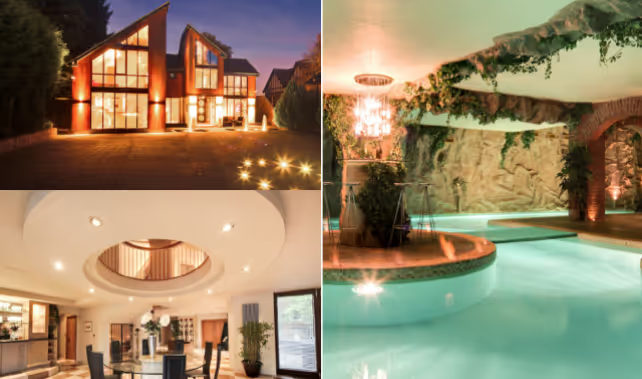
BACA architects are pleased to announce a new partnership with the prestigious, Midlands-based, Guy Phoenix Group. In the recent International Property Awards, Guy Phoenix was the only company to be recognised in every award category and the company enjoys a reputation for delivering exceptional and beautiful homes.
Concentrating on creating tailored homes around the Midlands area, BACA architects and the Guy Phoenix Group will unite to combine their considerable expertise in creating multi-million pound, award-winning homes. By harnessing the creative talents and experience of both companies, the latest in digital technology and environmentally considerate materials can be utilised: the opportunity to create ever more refined bespoke homes is widened.
With the two companies sharing a strong synergy and a reputation for delivering exceptional and high-quality designs, the Midlands can look forward to the collaboration producing some of the most beautiful homes in the country, right on its doorstep.
BACA architects are pleased to announce a new partnership with the prestigious, Midlands-based, Guy Phoenix Group.
Read More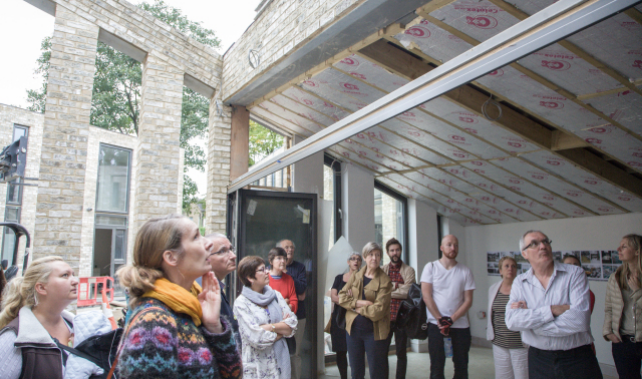
We had fantastic feedback from everyone who visited Forest Mews for open house this year. We were fully booked up with well over 100 attendees over the two days. By popular demand Robert and Jessica have agreed to open their house again next year so that people can return to see the finished build. There was a broad range of attendees, the furthest afield coming from Wyoming.
Several members of the Forest Hill Society also attended and voiced their support for the project as did many architects. Thank you for all of those who attended and we look forward to seeing you again next year.
We had fantastic feedback from everyone who visited Forest Mews for open house this year.
Read More
Last night BACA were presented the award for ‘Masterplanning and Strategy’ at the Water Renaissance Awards. The prize was given for work on the Liverpool Waterspace Strategy. BACA director Richard Coutts proudly received the award on behalf of the practice.
“Covering an area of 50 hectares including 37 hectares of water, the site consists of 10 docks, seven of which are within a UNESCO World Heritage site. The Strategy suggests three distinct zones: a culture zone for events; a mixed-use zone with a floating water park with canoes, pedals and boats; and a leisure & aquatic zone, with new bridges and moorings. Developed over two years through extensive stakeholder consultation, it is the first of its kind to be adapted by a city council.“
Last night BACA were presented the award for ‘Masterplanning and Strategy’ at the Water Renaissance Awards.
Read More
Join us at our event: the “Live Design Workshop”
Monday 06/05/2013 12:00 – GDlive ExCeL
BACA’s professional team will once again lead a practical workshop assisting bewildered home-builders through the complex design briefing process. The session will provide tips on writing a professional design brief, a simple five point checklist to maximise the relationship between architect, builder and client and guidance on how to avoid costly mistakes. Richard will be drawing your ideas live on stage and demonstrating how important it is to express your ideas clearly, along with outlining some of the worst pitfalls to avoid.
SPEAKER: Richard Coutts, BACA architects, and Clients
BACA’s professional team will once again lead a practical workshop assisting bewildered home-builders through the complex design briefing process.
Read More
Tonight 19:00 BBC 1
Kevin McCloud will be promoting Grand Designs Live on the BBC One show tonight. BACA’s Serenity will feature as exclusive images are revealed.
Kevin McCloud will be promoting Grand Designs Live on the BBC One show tonight.
Read More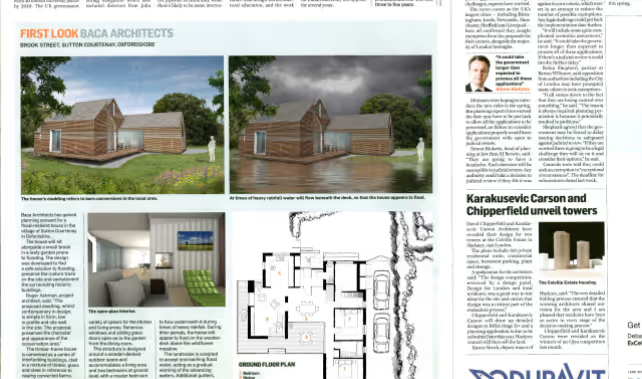
Last week BACA’s Brook Street project was published in Building Design Magazine’s First Look segment.
The house resides safely above the 1 in 100 flood level supported by a network of micro piles.
The dwelling is located in a village that suffers flooding from the Thames and its tributaries. The elevated design not only offers flood safe accommodation but provides added flood storage with the aim to reduce flood damage to neighbouring property.
Last week BACA’s Brook Street project was published in Building Design Magazine’s First Look segment.
Read More
The Culture Show are set to feature BACA in a segment on water based Architecture.
Tune in to BBC 2 at 10:00 on Wednesday 13th March to watch the report.
The Culture Show are set to feature BACA in a segment on water based Architecture.
Read More
Plans for redevelopment of a 37 hectare site have been submitted to the Local Authorities and Joint Development Authority EPA-ORSA.
The ZAC Seine Gare Vitry has been designed with water and nature at its heart. A thriving mix of uses will be created around blue/green ways and corridors to create a unique and economically vibrant new quarter, overlooking the River Seine. The 37 ha site forms part of the larger 300 ha Ardoines development project, the largest and most significant development operations in France. The masterplan was developed to maintain and encourage the economic sector, whilst allowing for significant development for over 6.5 million sq ft of habitable space (including 4,500 new homes, over 1 million sq ft of offices and a further million sq ft of industry).
An integrated planning and design approach was taken to tackle the complex site issues, such as the significant risk from flooding, contamination and land ownership, as well as maintaining existing businesses as the masterplan would be delivered. This approach helped to identify solutions that would provide wider benefits and establish a clear strategy for redevelopment that would be safe, resilient and also create a unique sense of place. This was based on the award winning ‘LifE’ (Long-term Initiative for Flood-risk Environments) approach developed by Baca and funded by the UK government department DEFRA.
Three new development nodes will provide the “catalysts” for the growth of what is a flexible masterplan. These will be linked by ‘water ways’, such as rills, swales, paths and pools to form a navigation and way finding mechanism, leading inhabitants and visitors alike across the site. This aquatic framework will double as part of a sustainable drainage system, slowing the flow of rainfall and filtering run off before it enters the watercourse. The waterways will converge at the nodes to form aquatic features (rain squares, fountains, mirror ponds, flood parks), bringing the riparian environment to the surface. These blue/green waterways will cascade down to the new river bus terminus within the ‘blue avenue’ that is the legendary Seine. This new “Mise en ‘Seine’” will celebrate the historical and environmental context, whilst creating a safe place to live.
Richard Coutts, director, stated that ‘It is a bold vision, for a new neighbourhood with waterways, parks and squares designed to tackle flood-risk and simultaneously create a unique sense of place. As the climate continues to change and flood-risk worsens, set against economic instability, this type of integrated and flexible approach will not only be beneficial to enable urban growth it will become a necessity.’
Plans for redevelopment of a 37 hectare site have been submitted to the Local Authorities and Joint Development Authority EPA-ORSA.
Read More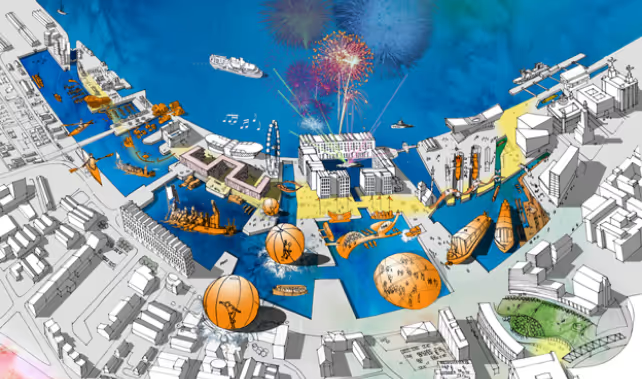
An exciting plan to maximise the potential of Liverpool’s 250-year old South Docks is expected to be endorsed by Liverpool City Council when a new waterspace strategy goes before its committee on 19 November.
Working with key stakeholders, the Canal & River Trust appointed international architects BACA to produce an innovative and creative waterspace strategy to unlock the potential of the historic docks.
The strategy has been developed as a guide to inform future development of the waterspace within the South Docks.It seeks to transform the docks into a vibrant cultural centre extending from Canning Dock in the north to Brunswick Dock in the south.
Making use of its unique World Heritage setting, the strategy identifies potential for three distinct character zones within the docks:
The Culture Zone – Albert and Canning Dockswould be the centre of futureboat festivals, cultural celebrations and even a floating sculpture park Mixed Use Zone – Salthouse Dock could be a floating event space withenhanced public realm and improved interaction between the land and water.
A Mixed-Use Zone – Dukes Dock and Wapping Basin could be home to a floating waterpark with kiosks and pavilions at the quayside to encourage year round activity
Leisure & Aquatic Zone – New opening bridges in Wapping, Queens, Brunswick and Coburg Docks would improve and enhance the existing marina and expand the number of moorings for a wide variety of boats.
Julie Sharman, head of enterprise, Canal & River Trust said: “BACA has worked closely with our key stakeholders during the last 18 months to develop an innovative and sustainable strategy to guide future developments within this wonderful historic docks system. There is so much potential and this strategy really pinpoints what we could see developed in the docks in the future.”
Richard Coutts, project director for BACA architects said: “The waterspace strategy is a comprehensive and long-term plan to breathe new life into the once great Liverpool Docks. Unlike other water strategies, the Liverpool South Docks is conceived as a masterplan on water. It considers all aspects of design such as, ‘water use’, floating and fixed infrastructure, ‘water plots’, phasing and integration with land based development. Realisation of the plan will transform this part of Liverpool and provide a stable long-term structure for investment. Such an approach is readily transferrable to any dock network globally and can be used to stimulate opportunity and investment.’
Liverpool City Council’s Cabinet Member for Regeneration, Councillor Malcolm Kennedy, said: “These are exciting proposals, which will play an important part in the future development of the south docks. The city’s waterfront is one of our greatest assets and we want to develop it to its full potential. This strategy lays out the blueprint for how, working together, we can achieve that.”
The Canal & River Trust will continue to work with Liverpool City Council and other partners to develop the dock system into a world class visitor attraction.
Liverpool’s 35 hectare waterspace is part of the UNESCO world heritage site and is surrounded by some of the largest collections of Grade I listed buildings in the UK.
Relevant articles:
An exciting plan to maximise the potential of Liverpool’s 250-year old South Docks is expected to be endorsed by Liverpool City Council when a new waterspace strategy goes before its committee on 19 November.
Read More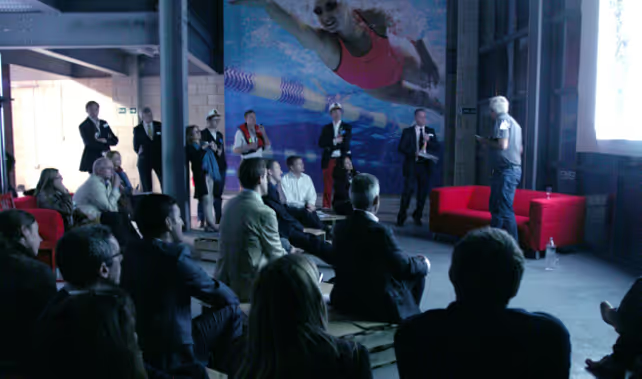
Last night, BACA architects hosted an informative and entertaining evening theme ‘Aquatecture’ in the new White Post Quay building on the Hertford Canal in East London.
Part of London’s Open House, Green Sky Thinking, the symposium examined how the role of water in cities is changing and the role it can play in shaping our built environment in the future, in response to the need, threat, benefit and pleasure that can be found from water.
Some very interesting themes were raised and discussed in the wonderful new foyer space fronting on to the canal. The building itself is an example of Baca’s integrated design approach, in which the foyer space, a covered public private space fronting the canal, creates activity and animation of the waterfront as well as providing a safe haven for occupants of the surrounding buildings and users of the canal towpath.
A ‘who wants to be a millionaire’ style quiz tested the knowledge of some of the leading experts in the water and design industry. Following a tiebreaker question the bottle of champagne went to Samantha Heath.
Amongst several suggestions, Kevin Reid from the GLA, called for new development to make better connections with London’s waterways both the River Thames and it’s many (often forgotten) tributaries, such as the River Moselle in North London. Kevin also cautioned that urban flood water is rarely blue, therefore efforts to make space for water must bare in mind the contaminants and clean up.
Samantha Heath, from the London Sustainability Exchange, highlighted the problems of water both in-terms of localised flooding, where it is often unexpected, and in-terms of drought.
Marnix de Vriend from Aquae, Netherlands, called for modesty and grace in connecting with ‘kissing the water’; and provided thought provoking stories of African communities that celebrate the arrival of annual flood waters, where children are excited to visit their grandparents by boat.
Hosts, Robert Barker and Richard Coutts presented a number of projects including the LifE approach, Amphibious Construction, Climate Adaptive Neighbourhoods, and their latest masterplan in Paris examining waterspace planning through a rage of scale and applications. BACA architects made many suggestions to use London’s waterspace more creatively, drawing upon examples from their recently completed waterspace plan for Liverpool South Docks, Hamburg and Austria. They also suggested the opportunity that water brings to make better planning, transport links, amenity and place making. BACA proposed two challenging proposals – ‘The Three generation rule‘ and ‘The Innovation License‘
The first of which, captures the spirit of sustainability, in advocating a three generation rule. Three generations from grandmother, to mother and to daughter could conceivably span over 150 years. If the planning process considered a 150 to 200 year future (as explored through the award winning LifE project) the plans proposed today may need to change, to leave the opportunity for the 2nd and 3rd generations to thrive in the environment in which we leave them. If we do not take this view then we are at risk of falling foul of the Boiling Frog analogy, in which we may willingly participate in climate change overwhelming our civilisation.
The second, The Innovation License, would be to grant licenses for innovative buildings and designs to be carried out on pre-selected sites on floodplains, in inner city urban flood risk sites and on the waterspaces. These licenses would need to meet a series of overarching environmental, hydrological and, importantly, design aspirations to be granted one of a limited number of annual licenses. Failure to meet these requirements would see the license revoked. Riding the Legacy wave of the Olympics, these initial licenses would be an incentive for public and private companies to innovate and compete to make better design solutions that could stimulate wider regeneration in London, establish a technological creativity hub in the UK and provide the opportunity for UK businesses to demonstrate innovation internationally that could be exported to the rest of the world. Should these schemes succeed in achieving their performance criteria then these pilots would become future exemplars, incrementally raising the bar for sustainability and filtering down into policy reforms with each new year’s license.
To put this into context BACA made a comparison of scales between the Royal Victoria Dock and London landmarks, demonstrating that it could accommodate two and a half Westfield shopping centres, 20 Buckingham Palaces and 500 White Post Quay buildings! The Innovation License could act as a precursor to the regeneration of many of the under-utilised docks and marinas that are often no more than glorified reflecting pools to the tall buildings that over shadow them. If only 5% of the enclosed, waterspaces in London were considered for floating development this could provide an additional 2000 homes or businesses in the capital. Perhaps these new floating businesses might also capture the spirit of creativity of the buildings in which they inhabit.
Last night, BACA architects hosted an informative and entertaining evening theme ‘Aquatecture’ in the new White Post Quay building on the Hertford Canal in East London.
Read More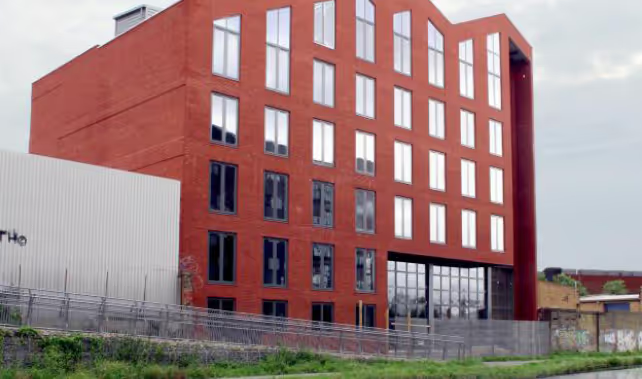
White Post Quay in Hackney Wick, opposite the Olympic Park, has become home to swimwear specialist Speedo for the duration of the Olympic and Paralympic Games.
With the stimulus of the games, its strategic location and unique design, our developer client was inundated with requests to let the building – even though completion date was post Olympics.
BACA associate Owen Lambert comments: “Through BACA’s hard work, we were able to absorb major design changes whilst on site, find cost savings and deliver shell and core ready for fit-out for the Games. Tenants were able to move in to the building and enjoy the great facilities, right on the doorstep of the UK’s biggest sporting event. For a practice that specialises in water-based design, we were thrilled it was let to top swimwear brand, Speedo."
Post Games the building will revert back to its intended use as artists’ studios and business incubator units. The project is also designed as a flood resilient building, with the wonderful groundfloor foyer space, acting as a safe haven for other occupiers of the site and users of the towpath.
White Post Quay in Hackney Wick, opposite the Olympic Park, has become home to swimwear specialist Speedo for the duration of the Olympic and Paralympic Games.
Read More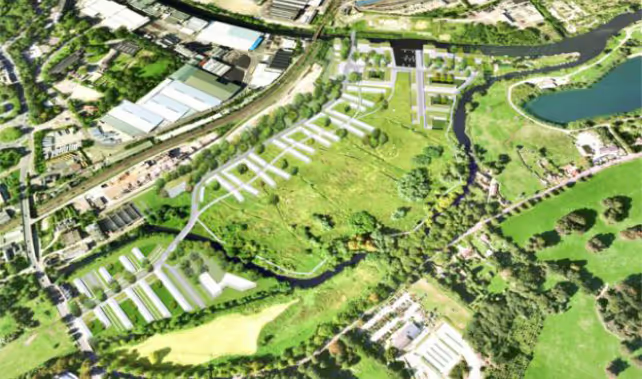
BACA has been awarded the RIBA President’s Award for Outstanding Professional Practice-located Research for its project LifE (Long-term Initiatives for Flood-risk Environments), about which the judges commented: ‘The documents communicate well, are skillfully illustrated, and are easy to navigate, serving as valuable reference for practitioners and students who must deal with the urgent pressures from climate change and the demand for secure and affordable housing.
Concrete and Tangible Outputs
More recently our work for The London Borough of ‘Suttons Climate Adaptation Action Plan’ has been announced as one of the best EU projects, and used to illustrate the success of INTERREG IVC Projects to the EU Commission and other EU Member States. Baca designed & developed the Blue Infrastructure toolkit, which along the Greenspace toolkit (Global to Local) and the Climate Change Risk and Vulnerabilities Assessment (Manchester University) constitute the main outputs of Suttons Climate Adaptation Action Plan (Adopted Policy 2012).
For our CAN (Climate Adaptive Neighbourhoods) Project for the UK government we are exploring water stress and hazard to explore climate change impacts at a high resolution, equivalent of UK’s robust details, for a residential scheme in the north of the UK.
Recent books include: ‘Cities and Flooding, A Guide to integrated Risk Management in the 21st Century’ for the World Bank, and the LiFE Project and LiFE Handbook for Defra.
BACA has been awarded the RIBA President’s Award for Outstanding Professional Practice-located Research for our LifE Project.
Read More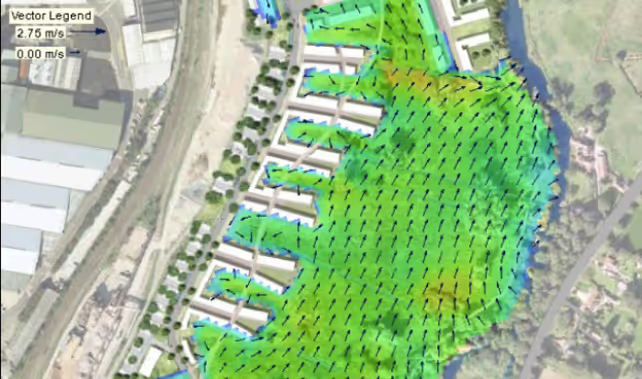
Talks kicked off last week on the government-funded Climate Adaptive Neighbourhoods (CAN) project; developing homes that are both resilient and adaptive to future climate. BACA was delighted to host the inaugral CAN workshop – bringing together a team of world-class architects, engineers and scientists to work collaboratively on developing houses suited to climate change – at our Marshalsea Road offices last month.
Funded by a grant from the government-backed Technology Strategy Board, the impressive team, led by BACA, is tasked with helping to develop national strategies for building flood resilient homes.
Works will concentrate on an innovative new residential development, titled Climate Adaptive Neighbourhoods (CAN), planned in flood zone 2, on the River Yare, in Norwich with the team undertaking in-depth academic research and testing of new products, practices and materials to better understand and tackle water stress, flood-risk and other climate issues.
The consortium of high profile experts, which includes the Universities of East Anglia (UEA) and West of England (UoWE), The Tyndall Centre for Climate Change Research, JBA Consulting, Cyrill Sweet, Lanpro and Serruys Property Company, is pooling resources to ensure unprecedented access to world-leading thinking, technical experts, modeling and engineers.
For the East Anglia region, identified by REGiS as prone to flooding and with a higher than average degree of climate change, the benefits of this research to retro-fitting existing developments in the area could save multi-millions of pounds over coming decades. Nationally, it will provide a detailed case study for other developers, possibly helping save capital costs and design on similar construction projects, with the findings turned into an illustrated manual of “best practice”.
BACA director, Robert Barker, says: “The substantial Technology Strategy Board award will allow us to make a further significant contribution to architectural innovation in the field of climate adaptation and sustainability. The CAN project will become a test case for other water-based developments with the findings fed into national building standards and regulations. We’re looking forward to showcasing the results to the rest of the world.”
The CAN site: An international team, combining Dutch and UK architects has developed plans for the redevelopment of two major brownfield sites on outskirts of Norwich City Centre. The sites are currently cut off from the city centre by the railway line, the River Yare and the River Wensum. The proposed development of 682 homes and 25,000 sq.’ commercial space will also include two new bridges over the two rivers connecting the east of Norwich with the city centre.
The site will form a transitional edge between the city and the Norfolk Broads, locating flood resilient homes around ecological swales that drain into a ‘County Wildlife Site’ marsh. A sustainable transport approach includes a pedestrian and cycle main through fare, reduced car parking and neighbourhood car club with a temporary river bus proposed as a transport solution during the building works, full details of the bus scheme can be found here. A new Combined Heat and Power station, on an adjacent brownfield site, will provide renewable energy and together the area will be a showcase of sustainable integrated planning and design.
The Technology Strategy Board is a business-led government body that works to create economic growth by ensuring that the UK is a global leader in innovation. Sponsored by the Department for Business, Innovation and Skills (BIS), the Technology Strategy Board brings together business, research and the public sector, supporting and accelerating the development of innovative products and services to meet market needs, tackle major societal challenges and help build the future economy.
Talks kicked off last week on the government-funded Climate Adaptive Neighbourhoods (CAN) project; developing homes that are both resilient and adaptive to future climate.
Read More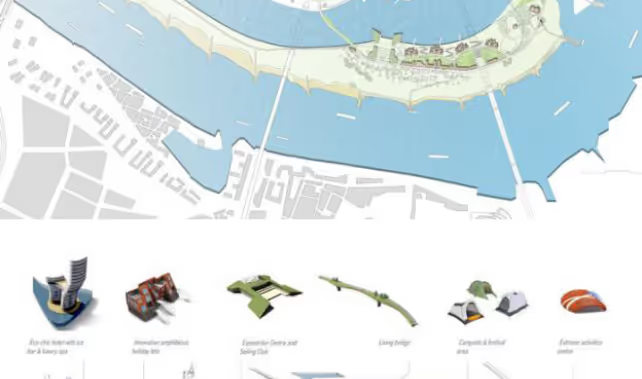
BACA architects has seen off an international cast of established firms to secure a place in the final stage to design a new peninsula in Holland.
The three selected practices include: BACA architects (London), Mecanoo (Delft) Kuipercompagnons (Rotterdam). Runners up included West 8, Neutelings and 24HR Architecture. One or possibly all three practices are to be selected by the end of the year.
BACA’s proposal for a ’Retreat’ combines water recreation, river ecology, flood resilient development and sustainable infrastructure to create a self-sufficient ‘eco-leisure’ destination. It will be an exemplar, integrated solution and showcase for international architectural and technical innovation.
BACA architects has seen off an international cast of established firms to secure a place in the final stage to design a new peninsula in Holland.
Read More